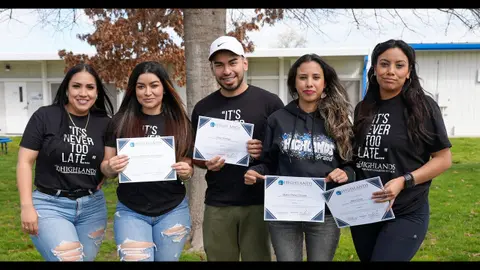
It’s Never Too Late: High School for Adults | Highlands Community Charter & Technical Schools

When most of us hear the words “charter school,” we immediately think about children, classrooms, and the familiar K through 12 education model. Highlands Community Charter and Technical Schools asks us to think differently.
My conversation with Jonathan Raymond, CEO and Executive Director of Highlands, introduced an educational model designed specifically for adults 22 and older who do not have a high school diploma. The average Highlands student is over 40. Seventy percent are parents, and about 88 percent speak a language other than English as their native language.
Many are immigrants and refugees. Some are formerly incarcerated. Others simply reached adulthood without being adequately served by the traditional education system. Some arrive in the United States with advanced degrees from their home countries, only to discover those credentials may not translate easily into employment here. Others arrive without literacy even in their native language.
What connects them is something far more important: they are still trying.
That may be the most powerful idea behind the Highlands motto, “It’s Never Too Late.”
Highlands is a public high school for adults, offering high school diploma pathways, English-language instruction, career and technical education, and foundational courses at no cost to students. There are in-person classes, morning and evening schedules, and an independent study option for students who need greater flexibility.
That flexibility matters. These are not traditional high school students. Many are parents, caregivers, and adults working one, two, or even three jobs. They may stop and restart their education because life gets in the way. Highlands has built multiple on-ramps and off-ramps so students can continue moving forward rather than seeing one interruption as the end of the road.
And education is only part of what many students need.
Highlands provides academic counselors, career coaches, job counselors, student navigators, and social workers. Jonathan described the school as more than a place to attend class. For some students, it becomes a second home where they feel safe, respected, seen, and heard.
The demand is clearly there. Highlands began the prior school year with about 900 students. At the time we recorded this conversation in late August, enrollment had grown to nearly 2,200 students across six locations, with additional students waiting to enroll.
English-language instruction is one of the greatest needs. Jonathan pointed to the millions of adults in California who do not have a high school diploma and the reduction of adult education opportunities across the state. For someone trying to build a life in a new country, English proficiency can be the bridge to employment, independence, participation in a child's education, and the ability to navigate everyday life.
But this episode is also about organizational recovery.
Jonathan returned to Sacramento to lead Highlands after a highly critical state audit identified serious compliance and attendance-related concerns. He was candid about the condition of the organization he inherited and equally clear about what needed to change.
The priorities were to restore trust and integrity, raise standards, and make decisions in the best interest of students.
Just over a year into that work, Highlands had fully implemented all 18 recommendations made by the state auditor. Its charter revocation was overturned by the Sacramento County Office of Education, and the school received a six-year accreditation from the Western Association of Schools and Colleges.
Those accomplishments matter because accountability and mission cannot be separated. An organization can serve a population with tremendous need, but it still has a responsibility to steward public resources well, measure outcomes, and earn the confidence of the community.
Jonathan also credits community partners for helping Highlands survive and rebuild. La Familia, Lao Family Community Development, Mack Road Partnership, SETA, SALAM Islamic Center, and others continued to support the school during a difficult period. Those partnerships helped connect Highlands to the communities it exists to serve.
Now the conversation is turning toward what adult education could become.
Jonathan believes systems designed around traditional high school students do not always make sense for adults. He wants greater flexibility in schedules, teaching models, funding, credentialing, and accountability. Rather than focusing primarily on classroom seat time, he argues for more attention to outcomes: Did the student learn English? Complete a course? Earn a diploma? Move into higher education? Get a job? Increase their wages?
Perhaps the most memorable stories in the episode are the students who refuse to quit. One former student returned to education after involvement with the criminal justice system, eventually graduated from Sacramento State and entered a master's program. Another student in her 70s remained determined to finally earn her high school diploma because of what that accomplishment meant to her and her family.
Highlands still describes itself as a work in progress. But there is something compelling about an organization asking adults who may have been overlooked by traditional systems to believe in second chances while the organization itself is experiencing one.
Students rebuilding their futures. A school rebuilding trust. A community choosing to support both.
It really is never too late.

Podcast Host
Broadcaster pro turned podcast leader, Jeff Holden created and hosts “The Non Profit Podcast Network”. A podcast and platform driven by his passion to serve, Jeff aims to revolutionize the way non-profit organizations communicate their stories for the betterment of their organizations.
Jeff made the successful leap from broadcast to digital audio in 2013 founding MultiPoint Content Strategies and Hear Me Now Studio. Under his leadership, these ventures have flourished, producing dozens of programs, increasing brand awareness and financial growth for his clients through authentic storytelling and coaching to directly target each company’s specific niche market.
Included in those programs are the award winning “Financial Sobriety” podcast and his own niche health podcast “Imperfect Heart”.
Join Jeff to learn how non-profits are working to solve seemingly impossible challenges today, and hear stories from the amazing people who are taking charge and leading their teams to accomplish their missions, grow toward their vision, and do it in the realm of their stated values.
When he's not hosting, producing, consulting, or spending time with family, you can likely find your host somewhere in the middle of nowhere practicing his two wheeled therapy peddling a steep climb in the Sierra foothills or on a local river attempting to keep his kayak upright.

GiGi’s Playhouse Sacramento Builds Independence and Belonging, One Opportunity at a Time